Employee Shuttle Service: Commuter & Campus Routes
An employee shuttle service is a route that runs the same way every working day: a transit station to a campus at shift change, a loop between two buildings, a late-evening run for people who finish after the last train. This page is for the HR or facilities lead deciding whether a shuttle would actually be ridden, which vehicle to put on it, and how to start without committing to a year of empty seats. We size the vehicle to the measured ridership on each run, publish a schedule people can trust, and adjust the route as the counts come in. A pilot of a few weeks tells you more than any survey. Send the two ends of the route, the shift times and a rough headcount, and we will propose a schedule and a price.
Send us the date and the route and we will come back with the exact vehicle, the hours, and the complete total in writing before you pay anything. Call (844) 725-4257, open the live chat, or send the form — a person picks it up either way, and there is no charge for asking.
Get a Free Quote
No obligation • Call (844) 725-4257 or open the live chat if you would rather talk
What size vehicle should we use for an employee shuttle?
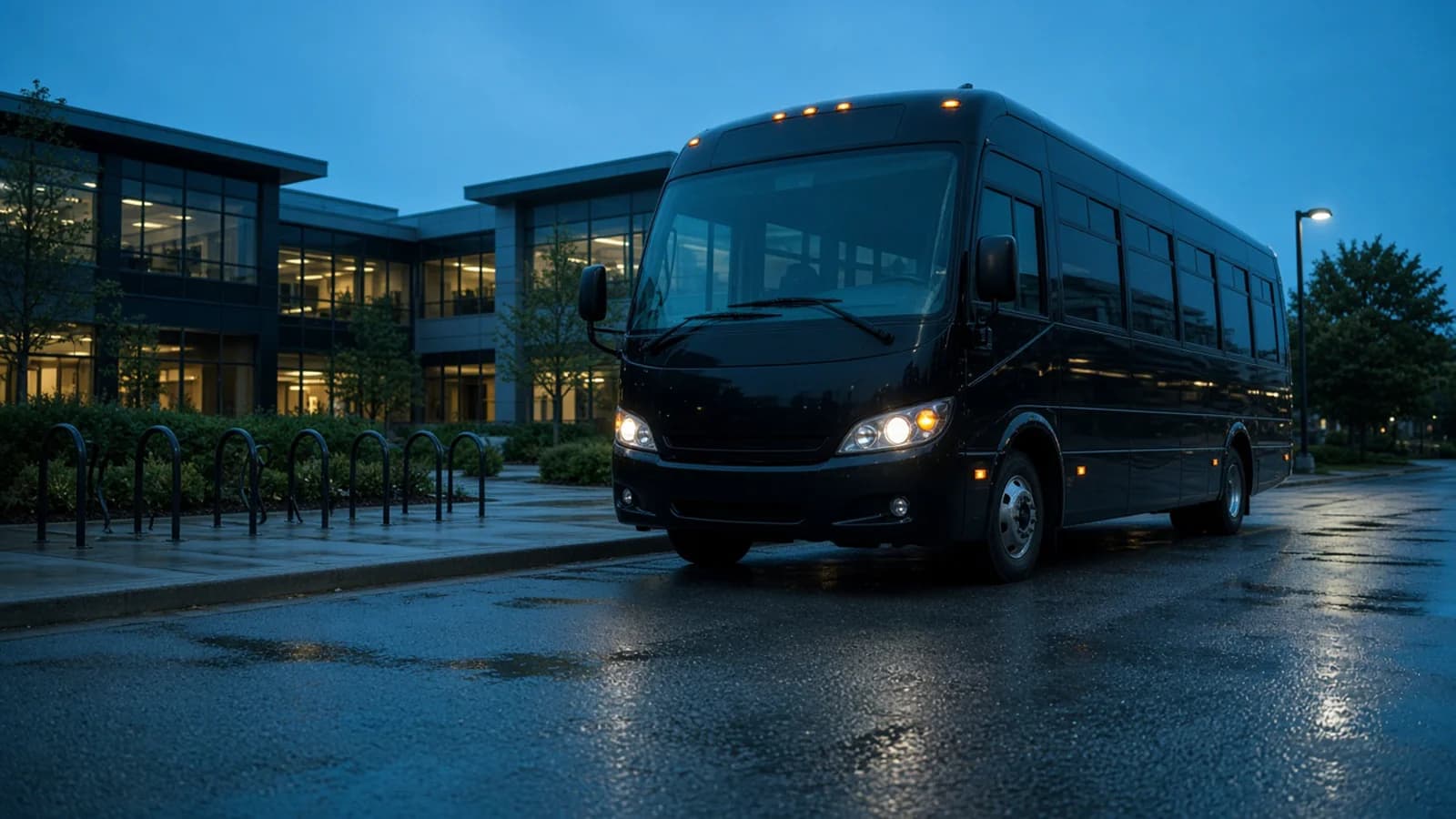
Size each run separately. The morning peak from a rail station might fill a 24-passenger mini bus or a coach, while the ten o'clock run and the late shift might carry six people, which is a job for a 14-passenger executive Sprinter. We start with your headcount estimate, count actual boardings on every run during the pilot, and move vehicles up or down from there. A shuttle that runs mostly empty costs more and gets cancelled; a right-sized one stays in the budget.
Who books this
An HR director at a suburban campus where the nearest train station is a long walk. A facilities manager whose parking lot is full by nine and who needs another answer before the next lease. A sustainability lead counting commute miles. A hospital or university administrator with staff on a satellite lot at shift change. An office manager with a summer intern cohort that arrived without cars.
Ideal Use Cases
A morning and evening run between a rail station and a suburban office campus
A campus loop between two buildings that used to be a long walk in August
A late-night run for shift workers who finish after the last bus has gone
A summer intern shuttle from a housing block to headquarters on a fixed schedule
A remote parking lot shuttle during a construction project or a company all-hands
A hospital staff shuttle from a satellite lot timed to shift change
Travel & Logistics Considerations
Route design starts with where people live and when they start. A ZIP code list, not home addresses, tells us where a stop earns its place, and the shift schedule sets the run times.
Vehicles are matched to the run, not the program. A 14-passenger executive Sprinter serves a thin late-night route, a 24-passenger mini bus fits a campus loop, and a 56-passenger coach carries the morning peak.
A stop has to be somewhere a bus can legally pull in and people can wait safely: a lit spot out of the traffic lane, with permission where it is not your land.
Frequency drives ridership. A run every fifteen minutes at the peak gets used; a run every forty-five loses people to their own cars, so we would rather run a smaller vehicle more often.
People ride what they can see. A schedule page, a live location link for the vehicle on the route, and signs at each stop matter more to adoption than anything about the bus itself.
Mistakes to Avoid
- ✗ Putting the largest coach on every run and watching it ride empty. Match each run to its measured count and step up when the numbers say so.
- ✗ Launching before asking employees where they live and when they work. The route has to go where people are, not where the org chart is.
- ✗ Picking stops a bus cannot legally serve. Check curb rules and property permission at each stop before the schedule is printed.
- ✗ Assuming people will find out. Announce the route, post the schedule and put a sign at every stop, or the seats stay empty.
How Far Ahead to Book
Allow a few weeks from the first call to the first run: enough to gather the ZIP code list and shift times, walk the stops, agree the schedule and sign the contract. We would rather start with a pilot of several weeks on a modest vehicle than commit to a year of a coach nobody rides, and the contract sets out how the vehicle and schedule can change as counts come in. Send the route, the shift times, a rough headcount per run and your start date.
From our inquiry data
What group planners like you have asked for — Employee Shuttle Service
Patterns across all the markets our reservation desk answers for, counted from the inquiries it handled mid-2023 through summer 2026 across every brand it books for. These describe requests and historical quotes, not bookings, and not current prices or local availability.
Event dates in our historical inquiry data cluster in May, September, October (each roughly 10–11% of the year's events), while January is the quietest month at about 5%.
Scope: all markets combined · Basis: inquiries · Sample: more than 10,000 records · Reviewed 2026-09-04
Planning starts early in the year: January accounts for about 9% of inquiries but under 5% of event dates, while May and September–October carry more events than inquiries — a sign that spring and fall dates are requested weeks to months ahead.
Scope: all markets combined · Basis: inquiries · Sample: more than 10,000 records · Reviewed 2026-09-04
Across more than 10,000 qualifying inquiries recorded mid-2023 through summer 2026, the typical group was about 15 passengers; half of all requests fell between 10 and 20 people.
Scope: all markets combined · Basis: inquiries · Sample: more than 10,000 records · Reviewed 2026-09-04
How these figures are produced, rounded, and privacy-protected: customer-data methodology. Last reviewed 2026-09-04.
What stands behind this
A standing shuttle is only useful if it runs the same way every day, so we assign the route a regular chauffeur where scheduling allows and a written schedule that the riders can see. We hold the title on every vehicle and the employment contract on every chauffeur, and the route, the vehicle and the monthly total are on one contract with one invoice.
Operating authority and insurance status are verifiable in the FMCSA systems rather than only here. Ask us for the certificate and the docket number and check them before you pay a deposit. How we source what we publish.
FAQ
Employee Shuttle Service: Questions We Get
The questions this trip actually turns on, answered straight.
Can we run a pilot employee shuttle before committing to a contract?
Can employees see where the shuttle is in real time?
How do we get employees to actually ride the shuttle?
Can the shuttle route or schedule change after we start?
Ready to Check This Trip?
Submit the date, passenger count, route, stops, and vehicle request so availability and written terms can be checked.
No obligation · Your date is held when the contract is signed
Related Pages
Events
Related Events
Explore planning guides for other events and transportation requests.
Blog
Related Articles
Helpful guides, tips, and insights for planning your next group event.

The Ultimate Party Bus Rental Guide for First-Timers
Everything you need to know before renting a party bus — from choosing the right size to BYOB etiquette and booking tips.
10 Bachelor Party Ideas That Will Make You a Legend
From brewery tours to casino crawls, here are 10 epic bachelor party ideas — all made better with a party bus.
Interactive Tools
Free Planning Tools
Use our interactive tools to plan every detail of your group transportation.
Party Bus Cost Calculator
Estimate your rental cost based on group size, hours, day of week, and city tier. Get an instant price range with a detailed breakdown.
BudgetingGroup Size Vehicle Matcher
Tell it how many people are actually coming and it returns the vehicles that fit, each with its real seated capacity and an honest note on where it works and where it does not.
PlanningItinerary Builder
Lay your stops out in order, set how long you want at each one, and read the whole evening back as a timeline with travel between venues already accounted for.
PlanningTip & Gratuity Calculator
Work out a gratuity for your chauffeur at the percentage you choose. Whether gratuity sits inside your rate or is added at service is stated on your own quote.
BudgetingMulti-Stop Route Optimizer
Give it your list of addresses in any order and it rearranges them into the shortest sensible driving loop, so you spend the night at your stops rather than crossing town between them.
LogisticsVehicle Comparison Tool
Compare 2–3 vehicles side by side on capacity, price range, amenities, and best use cases.
LogisticsGet Started
Request Your Free Quote
Tell us the date, the headcount and where you are going, and we will come back with the vehicle, the hours and the price. Three ways to reach us — pick whichever is easiest.